



Beyond the pages
- ByNeha Singh --
- 19 Oct 2026 --
- 0 Comments
Fundamental Rights in India: What Every Citizen Should Know
By Neha Singh, ABBS School of Law
Fundamental Rights sit in Part III of the Constitution, Articles 12 to 35.
Think about the last time you posted an opinion online, prayed at a place of your choice, or walked into a government office expecting to be treated like anyone else. You probably did not think twice. That is because the Constitution quietly protects you every day.
Those protections are called Fundamental Rights. They are in Part III of the Indian Constitution, Articles 12 to 35. They protect your freedom and dignity, and they stop the government from acting arbitrarily. If you study law, you will come back to these articles again and again. If you don't, they still matter, because they are about you.
What Are Fundamental Rights?
Fundamental Rights are basic rights that the Constitution guarantees to people in India. Their main job is to limit the power of the State.
Article 12 explains who counts as “the State.” It covers the Union and State governments, Parliament, State legislatures, and local and other authorities. Article 13 says that a law which goes against these rights is void to the extent of the conflict.
And if one of your rights is violated, you can go to court to enforce it.
The Six Fundamental Rights
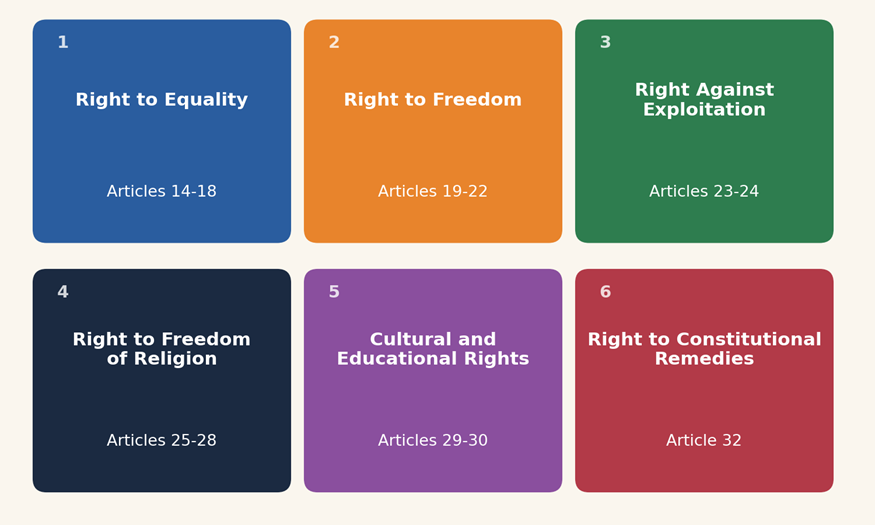
The six categories of Fundamental Rights at a glance.
1. Right to Equality (Articles 14–18)
- Article 14: Everyone is equal before the law and has equal protection of the laws.
- Article 15: The State cannot discriminate on grounds of religion, race, caste, sex or place of birth.
- Article 16: Everyone gets equal opportunity in public employment.
- Article 17: Untouchability is abolished.
- Article 18: Titles are abolished, except military and academic distinctions.
Equality does not always mean identical treatment. The Constitution allows special provisions, such as reservations, to help groups that have faced disadvantage.
2. Right to Freedom (Articles 19–22)
Article 19 gives citizens six freedoms:
- Speech and expression
- Peaceful assembly without arms
- Forming associations or unions
- Moving freely across India
- Living and settling anywhere in India
- Practising any profession, trade or business
These freedoms have limits. Under Article 19(2), speech can be restricted for reasons such as the security of the State, public order, decency, defamation and contempt of court. The restriction has to be reasonable.
Article 20 protects people from unfair punishment, for example being punished twice for the same offence. Article 21 protects life and personal liberty. Article 21A gives children between six and fourteen the right to free and compulsory education.
Article 22 protects people who are arrested. They must be told the grounds of arrest, they can consult a lawyer, and they must be taken before a magistrate within 24 hours. Preventive detention laws follow different rules.
3. Right Against Exploitation (Articles 23–24)
- Article 23: Bans human trafficking, begar and forced labour.
- Article 24: Bans employing children under fourteen in factories, mines and other hazardous work.
4. Right to Freedom of Religion (Articles 25–28)
India is a secular country. Everyone can follow, practise and spread their religion, subject to public order, morality and health.
- Article 25: Freedom of conscience and religion.
- Article 26: Religious groups can manage their own religious affairs.
- Article 27: No one can be forced to pay taxes for promoting a particular religion.
- Article 28: Rules on religious instruction in certain educational institutions.
5. Cultural and Educational Rights (Articles 29–30)
- Article 29: Any group with its own language, script or culture can protect it. No citizen can be refused admission to a State-run or State-aided institution only because of religion, race, caste or language.
- Article 30: Religious and linguistic minorities can set up and run their own educational institutions.
6. Right to Constitutional Remedies (Article 32)
A right means little if you cannot enforce it. Article 32 lets you go straight to the Supreme Court when a Fundamental Right is violated. High Courts can also issue writs under Article 226. The courts can issue five kinds of writs:
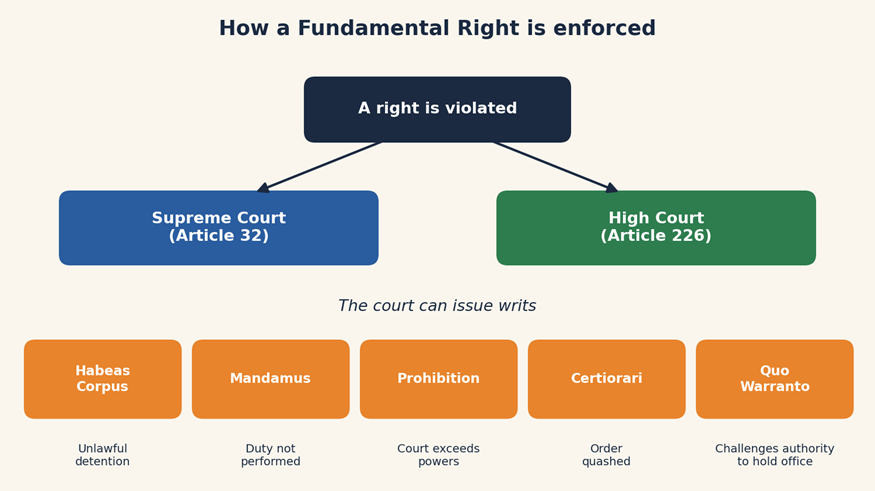
How a violated right reaches the courts, and the five writs.
- Habeas Corpus: against unlawful detention.
- Mandamus: orders a public authority to do its legal duty.
- Prohibition: stops a lower court or tribunal from going beyond its powers.
- Certiorari: cancels an order passed by a lower court or tribunal.
- Quo Warranto: asks by what authority someone holds a public office.
Dr. B. R. Ambedkar called Article 32 the “heart and soul” of the Constitution.
Three Cases Every Law Student Should Know
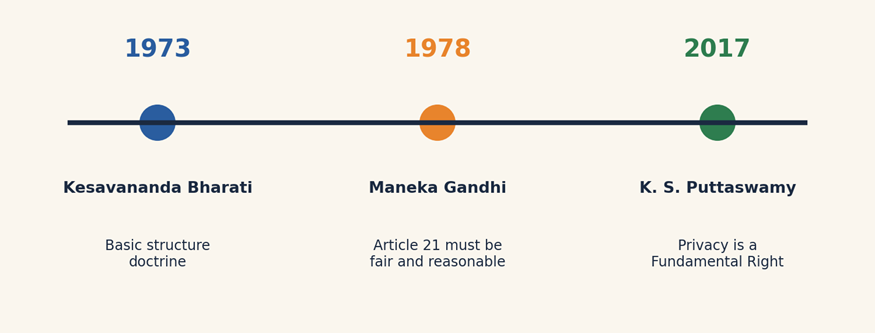
Three landmark judgments on Fundamental Rights.
- Kesavananda Bharati v. State of Kerala (1973): Parliament can amend the Constitution, but it cannot destroy its basic structure.
- Maneka Gandhi v. Union of India (1978): A law that takes away personal liberty must follow a procedure that is fair, just and reasonable.
- Justice K. S. Puttaswamy v. Union of India (2017): A nine-judge bench unanimously held that privacy is a Fundamental Right. It matters more every year as our personal data moves online.
Are Fundamental Rights Absolute?
No. Most of them can be limited so that one person’s freedom does not harm others or the public. Courts decide whether a restriction is reasonable and falls within what the Constitution allows.
Final Thoughts
Fundamental Rights protect liberty and equality, ban exploitation, respect our differences and give us a way to seek justice. But a right on paper is only as strong as its enforcement. Courts, public bodies and ordinary citizens all share that job.
Your turn: Which Fundamental Right do you think affects daily life in India the most? Tell me in the comments, and subscribe for more posts on constitutional law.
About the Author
Neha Singh is a law student at ABBS School of Law. [Add 1–2 lines: your year or batch, areas you are interested in such as constitutional law, any moot court, internship or reading interests, and why you started writing.]
RELATED Blog





comments