



Cost Inflation In Research Law.
1. Introduction
Cost Inflation in Research Law refers to the continuous or disproportionate increase in the financial expenditure associated with scientific research, technological development, academic investigations, clinical trials, pharmaceutical innovation, biotechnology, and publicly funded research programmes.
It examines how rising research costs affect the legality, accessibility, accountability, transparency, and fairness of research activities.
Cost inflation may arise from:
Increasing prices of laboratory equipment and scientific instruments.
Rising costs of chemicals, reagents, biological materials and research supplies.
Inflation in salaries of scientists, researchers and technical personnel.
Increased expenditure on clinical trials and regulatory compliance.
Expensive artificial intelligence, biotechnology and genomic research infrastructure.
Patent registration, licensing and intellectual property protection costs.
Delays in research projects and consequent budget overruns.
Foreign exchange fluctuations affecting imported research equipment.
Excessive administrative expenditure and procurement irregularities.
Cost inflation is not, by itself, a universally recognised independent legal doctrine. Rather, it is a developing subject of research governance, public finance, administrative law, intellectual property law, competition law and research ethics.
Its central legal question is:
How can the law ensure that increasing research expenditure does not undermine scientific progress, public accountability, institutional fairness and access to research benefits?
2. Meaning and Nature of Cost Inflation in Research Law
Cost inflation in research law involves three interconnected dimensions.
A. Economic dimension
This concerns the increasing financial resources required to conduct research. For example, a biotechnology project originally approved with a budget of ₹50 lakh may require ₹80 lakh because of increased equipment prices, imported materials and personnel expenses.
B. Legal dimension
This concerns the legal consequences of increased research expenditure, including:
Breach of research grant conditions.
Misappropriation of research funds.
Unjustified contract variations.
Procurement irregularities.
Failure to comply with funding agreements.
Unlawful diversion of institutional resources.
C. Ethical dimension
This concerns whether increased costs create inequalities in scientific opportunities, restrict access to essential medicines, or allow wealthy institutions and corporations to dominate scientific innovation.
Thus, cost inflation is not merely an accounting problem. It can become a question of legal responsibility and distributive justice.
3. Major Causes of Research Cost Inflation
| Cause | Legal significance |
|---|---|
| Equipment price increases | Procurement and contract compliance |
| Imported research materials | Customs, taxation and foreign exchange exposure |
| Clinical trial expenditure | Patient protection and regulatory compliance |
| Research delays | Contractual liability and grant accountability |
| Patent expenses | Intellectual property accessibility |
| Administrative overheads | Financial transparency and audit |
| AI and genomic infrastructure | Data protection and technological governance |
| Regulatory requirements | Compliance costs and institutional responsibility |
4. Legal Framework in India
Cost inflation in research is governed by several overlapping legal frameworks.
A. Constitution of India
Article 14 – Equality before law: Research grants, public procurement and institutional funding must be administered fairly and without arbitrary discrimination.
Article 21 – Right to Life: Where biomedical research affects patients, human dignity, safety and access to healthcare must be protected.
Article 19(1)(g): Protects lawful professional, scientific and commercial activities, subject to constitutional restrictions.
Article 51A(h): Recognises the importance of developing scientific temper, humanism and the spirit of inquiry and reform.
B. General Financial Rules, 2017
The GFR framework governs the financial administration of government grants and expenditure. Its relevance includes:
Proper utilisation of sanctioned research funds.
Maintenance of expenditure records.
Financial accountability.
Utilisation certificates.
Prevention of wasteful expenditure.
Compliance with procurement requirements.
The Comptroller and Auditor General's grant-in-aid audit framework specifically examines whether grants are utilised for their sanctioned purposes and whether financial management is economical.
Comptroller and Auditor General of India+1
C. Research-specific regulatory framework
Important instruments include:
Department of Science and Technology funding guidelines.
ICMR National Ethical Guidelines for Biomedical and Health Research.
New Drugs and Clinical Trials Rules, 2019.
Drugs and Cosmetics Act, 1940.
Patents Act, 1970.
Digital Personal Data Protection Act, 2023, where applicable to research involving digital personal data.
Applicable institutional grant agreements and procurement rules.
5. Important Judicial Decisions and Case Laws
The following judgments provide the legal principles relevant to cost inflation, although none establishes a standalone doctrine bearing that exact name.
1. Indian Council of Social Science Research v. Neetu Gaur and Others (2025 INSC 374)
Direct research-funding relevance
The Supreme Court considered the relationship between the Indian Council of Social Science Research (ICSSR) and a beneficiary research institution, the Centre for Research in Rural and Industrial Development (CRRID).
Legal significance:
Research grants are subject to institutional accountability.
Funding authorities have legitimate oversight responsibilities.
Financial and administrative irregularities can affect the continuation of grants.
The relationship between a funding authority and a research institution must be examined according to the applicable legal framework.
Application: Where research expenditure increases substantially, funding agencies may demand proper financial explanations, supporting documents and compliance with grant conditions.
VoxJuris
2. Tata Cellular v. Union of India (1994) 6 SCC 651
The Supreme Court explained the principles governing judicial review of government contractual and procurement decisions.
Key principles:
Government procurement must comply with fairness.
Administrative decisions must not be arbitrary.
Courts generally review the decision-making process rather than substitute their own commercial assessment.
Public authorities must act consistently with applicable legal standards.
Application: Research institutions purchasing expensive laboratory equipment cannot use cost escalation as an excuse for arbitrary procurement, favouritism or non-transparent contractual modifications.
3. Ramana Dayaram Shetty v. International Airport Authority of India (1979) 3 SCC 489
The Supreme Court held that government authorities must follow non-arbitrary standards when distributing public opportunities and entering into public contracts.
Application to research law:
If an institution receives increased public funding for a research project, the additional expenditure should be justified through transparent criteria. Selective financial advantages, discriminatory procurement and arbitrary allocation of research resources may raise Article 14 concerns.
4. Swasthya Adhikar Manch v. Union of India (2013) 3 SCC 778
Clinical research relevance
The Supreme Court addressed concerns surrounding clinical trials, including the protection of research participants and regulatory supervision.
Legal significance:
Human participants must receive appropriate protection.
Clinical trials require effective regulatory oversight.
Ethical standards cannot be subordinated to commercial research interests.
The government has an important responsibility to supervise clinical research.
Application: Rising clinical research expenditure cannot justify reducing participant protection, compromising informed consent or avoiding legally required compensation.
CDSCO+1
5. State of Punjab v. Ram Lubhaya Bagga (1998) 4 SCC 117
The Supreme Court examined the relationship between healthcare policy, financial resources and the State's obligations.
Legal significance:
The Court recognised that government healthcare policy involves financial constraints and changing economic circumstances, while remaining subject to constitutional requirements.
Application: Public research funding authorities may revise funding priorities in response to financial constraints. However, such decisions must remain lawful, rational and consistent with applicable obligations.
6. Centre for Public Interest Litigation v. Union of India (2012) 3 SCC 1
The Supreme Court examined the allocation of scarce public resources and the requirement of fairness in governmental decision-making.
Application: Scarce public research funds should be distributed through transparent, rational and legally defensible mechanisms. Increasing research costs make objective funding criteria particularly important.
6. Cost Inflation and Publicly Funded Research
Publicly funded research is particularly vulnerable to cost inflation because projects often depend on annual grants, institutional budgets and government procurement.
For example:
Suppose a government research institution receives ₹1 crore for a biotechnology research project.
| Expenditure | Original budget | Revised expenditure |
|---|---|---|
| Laboratory equipment | ₹30 lakh | ₹40 lakh |
| Chemicals and materials | ₹15 lakh | ₹22 lakh |
| Researchers' salaries | ₹20 lakh | ₹23 lakh |
| Clinical research | ₹15 lakh | ₹20 lakh |
| Administration | ₹10 lakh | ₹12 lakh |
| Other expenditure | ₹10 lakh | ₹13 lakh |
| Total | ₹1 crore | ₹1.30 crore |
Research budget escalation
Illustrative comparison of an approved and revised research budget.
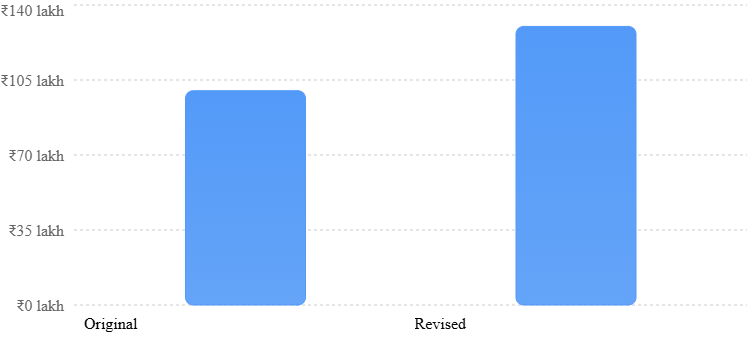
The additional ₹30 lakh raises several legal questions:
Was the increase caused by genuine market inflation?
Was the original budget improperly estimated?
Did the institution change the scope of research?
Were procurement procedures followed?
Was prior approval obtained from the funding authority?
Who is legally responsible for the additional expenditure?
The answer depends on the funding agreement, applicable financial rules, procurement conditions and the reasons for the increase.
7. Difference Between Genuine Inflation and Unlawful Cost Escalation
An important legal distinction is that every increase in research expenditure is not necessarily unlawful.
| Genuine cost inflation | Unlawful or unjustified escalation |
|---|---|
| Increase in market prices | Artificial price enhancement |
| Currency depreciation | Manipulated foreign exchange claims |
| Higher scientific equipment costs | Procurement collusion |
| Increased laboratory maintenance | False maintenance expenditure |
| Additional regulatory requirements | Unnecessary expenditure without justification |
| Unavoidable project delays | Deliberate or negligent delay |
| Approved expansion of research scope | Unauthorised scope modification |
This distinction is essential when determining financial liability.
For example, if imported scientific equipment becomes more expensive because of currency depreciation, the additional expenditure may be justified. However, if the supplier and institutional officials manipulate procurement prices, the issue may involve corruption, fraud and breach of financial regulations.
8. Institutional Accountability and Research Funding
Research institutions have a responsibility to ensure that rising expenditure does not compromise scientific integrity.
Their obligations include:
A. Financial transparency
Institutions should maintain:
Original approved budgets.
Revised expenditure statements.
Purchase invoices.
Vendor quotations.
Audit reports.
Utilisation certificates.
Records of additional funding approvals.
B. Cost-benefit assessment
Before approving substantial additional expenditure, institutions should evaluate whether the research project continues to offer sufficient scientific and public value.
C. Independent auditing
Publicly funded institutions should maintain effective financial auditing mechanisms to identify irregular expenditure, duplication and misuse of funds.
D. Performance accountability
Increased expenditure should be evaluated against actual scientific outcomes, project milestones and research deliverables.
An important policy concern has also been identified by NITI Aayog in its work on improving research and development in India. It discusses delayed fund disbursal, accounting difficulties and inadequate overhead provisions as obstacles to research institutions.
NITI Aayog+2
9. Cost Inflation in Clinical Trials and Pharmaceutical Research
Clinical trials involve significant expenditure on:
Participant recruitment.
Medical examinations.
Laboratory investigations.
Patient monitoring.
Insurance.
Regulatory approvals.
Adverse-event management.
Compensation for research-related injuries.
Indian clinical trial regulations place significant obligations on sponsors and research institutions.
Under the New Drugs and Clinical Trials Rules, 2019, compensation obligations arise in specified circumstances involving trial-related injury or death.
The ethical and financial implications are important: research sponsors cannot simply transfer legally required participant-protection costs to vulnerable participants.
The CDSCO framework also assigns Ethics Committees responsibilities relating to the rights, safety and well-being of research participants.
CDSCO+2
Relevant legal principle: Scientific and commercial expenditure must remain subordinate to legally protected human rights and research ethics.
10. Cost Inflation and Intellectual Property Rights
Research cost inflation has a direct relationship with intellectual property law.
Developing a new medicine, vaccine, medical device or biotechnology product can require enormous investment.
The Patents Act, 1970 provides a legal framework for protecting qualifying inventions while also recognising public-interest limitations.
Important provisions include:
Section 3 – Non-patentable inventions.
Section 48 – Rights of patentees.
Section 83 – General principles applicable to working of patented inventions.
Section 84 – Compulsory licensing.
Section 92 – Compulsory licences in special circumstances.
Important case:
Bayer Corporation v. Union of India, (2014) 6 SCC 684.
The Supreme Court upheld the legal framework concerning compulsory licensing and the interpretation of Section 84 of the Patents Act.
Relevance to research cost inflation:
A pharmaceutical company may argue that substantial research and development costs justify high product prices. However, intellectual property protection does not operate independently of statutory public-interest considerations.
The law must consider innovation incentives alongside access to essential medicines.
11. Legal Liability for Research Cost Inflation
Depending on the facts, different categories of liability may arise.
| Nature of misconduct | Potential legal consequences |
|---|---|
| Misuse of research grants | Recovery of funds and other applicable action |
| False expenditure statements | Civil, disciplinary or criminal liability |
| Procurement manipulation | Contractual and anti-corruption proceedings |
| Breach of grant conditions | Suspension or termination of funding |
| Negligent project management | Contractual or administrative liability |
| Clinical trial violations | Regulatory sanctions and compensation |
| Intellectual property violations | Patent-related legal remedies |
| Fraudulent financial reporting | Applicable civil or criminal proceedings |
For public officials, the Prevention of Corruption Act, 1988 may become relevant where the statutory elements of an offence are established.
For private research organisations, contractual obligations, company law, intellectual property law and applicable regulatory legislation may determine liability.
12. Judicial Review of Research Funding Decisions
Courts may intervene when decisions concerning research funding or expenditure involve:
Arbitrariness or discrimination.
Violation of statutory funding conditions.
Improper exercise of administrative powers.
Breach of natural justice.
Fraudulent procurement.
Misuse of public funds.
Violation of constitutional rights.
However, courts generally avoid substituting their own scientific or technical assessment for that of qualified research authorities unless a recognised ground for judicial intervention exists.
The principles in Tata Cellular and Ramana Dayaram Shetty provide an important foundation for reviewing public procurement and administrative decisions.
13. Emerging Challenges: AI, Genomics and Advanced Scientific Research
Modern research is increasingly expensive because of technological complexity.
Major emerging areas
1. Artificial intelligence research
Advanced computing infrastructure, cloud processing and high-performance computing create substantial recurring expenditure.
2. Genomic research
Genome sequencing, biological databases and precision medicine require sophisticated equipment, specialised personnel and long-term data storage.
3. Space research
Satellite development, launch systems, testing facilities and advanced materials can generate significant budget uncertainty.
4. Quantum computing
Quantum laboratories require specialised equipment, cooling systems and highly trained researchers.
5. Biotechnology
Gene editing, synthetic biology and advanced pharmaceutical development involve costly laboratory infrastructure and regulatory supervision.
These developments raise new legal questions:
Who bears the financial consequences of technological obsolescence?
Can research institutions recover additional costs from public funding authorities?
Who is responsible for inaccurate cost projections?
Can high research costs justify restricting public access to publicly funded discoveries?
How should governments regulate privately financed scientific research?
These questions suggest the need for a more comprehensive legal framework addressing research expenditure and technological accountability.
14. Proposed Legal Principles for a Cost Inflation Governance Doctrine
A developing Cost Inflation Governance Doctrine could be structured around eight principles:
Financial Proportionality: Research expenditure should remain proportionate to the project's scientific objectives.
Transparent Cost Revision: Every substantial budget increase should be supported by documented reasons.
Independent Financial Review: Significant cost escalations should undergo independent examination.
Research Continuity: Funding arrangements should avoid unnecessary interruptions to ongoing scientific work.
Public Accountability: Institutions receiving public funds should remain accountable for expenditure.
Scientific Independence: Financial restrictions should not arbitrarily interfere with legitimate scientific inquiry.
Ethical Cost Allocation: Increasing expenditure must not compromise research participants' rights.
Equitable Research Access: Financial barriers should not unnecessarily prevent access to important scientific discoveries.
15. Critical Legal Analysis
Cost inflation in research law creates a difficult balance between financial discipline and scientific advancement.
On one side, research institutions need sufficient funding to develop new technologies, medicines and scientific discoveries. On the other side, governments and funding authorities must prevent wasteful expenditure, procurement manipulation and misuse of public resources.
Excessive financial restrictions may discourage innovation, while insufficient financial supervision may encourage corruption and institutional inefficiency.
The legal objective should therefore not be simply to minimise research expenditure. It should be to ensure that research expenditure is reasonable, transparent, scientifically justified and consistent with public-interest obligations.
India particularly needs funding systems that account for inflation, foreign exchange movements, specialised equipment costs, laboratory maintenance and long-term research commitments.
16. Conclusion
Cost Inflation in Research Law is an important emerging interdisciplinary subject connecting constitutional law, administrative law, public finance, intellectual property, pharmaceutical regulation and research ethics.
The judgments in ICSSR v. Neetu Gaur, Tata Cellular, Ramana Dayaram Shetty, Swasthya Adhikar Manch and Bayer Corporation provide relevant judicial foundations for understanding research funding accountability, procurement fairness, clinical research protection and public-interest limitations on intellectual property.
Although Indian courts have not established a separate doctrine called Cost Inflation in Research Law, existing legal principles provide a foundation for developing one.
The ultimate objective is to ensure that rising research costs do not become an instrument of financial exploitation, scientific inequality or institutional irresponsibility, but are managed through transparent, accountable and innovation-supportive legal governance.
17. Important Reference Materials
For further academic research:
Supreme Court – ICSSR v. Neetu Gaur (2025).
NITI Aayog – Ease of Doing Research and Development in India.
CDSCO – Ethics Committee and Clinical Trial Oversight.
CAG – Audit of Project Management.
Suggested academic classification: Research Funding Law → Research Financial Governance → Research Cost Inflation → Research Cost Escalation Accountability → Equitable Research Financing.
This framework can be developed into a separate chapter of an advanced monograph on Research Law and Scientific Governance.
RELATED Blog



comments