



Rin Compliance Governance.
RIN Compliance Governance (Renewable Identification Number System)

4
1. Concept and Legal Framework
RIN (Renewable Identification Number) Compliance Governance refers to the regulatory, operational, and internal control framework governing the creation, trading, reporting, and retirement of RINs under the Renewable Fuel Standard (RFS) program in the United States.
A RIN is a unique 38-character code assigned to a batch of renewable fuel (e.g., ethanol, biodiesel). It functions as a compliance credit to ensure that obligated parties (refiners, importers) meet renewable fuel blending mandates.
Key legal sources include:
- U.S. Clean Air Act (42 U.S.C. § 7545(o))
- EPA RFS Regulations (40 CFR Part 80)
2. Core Elements of RIN Compliance Governance
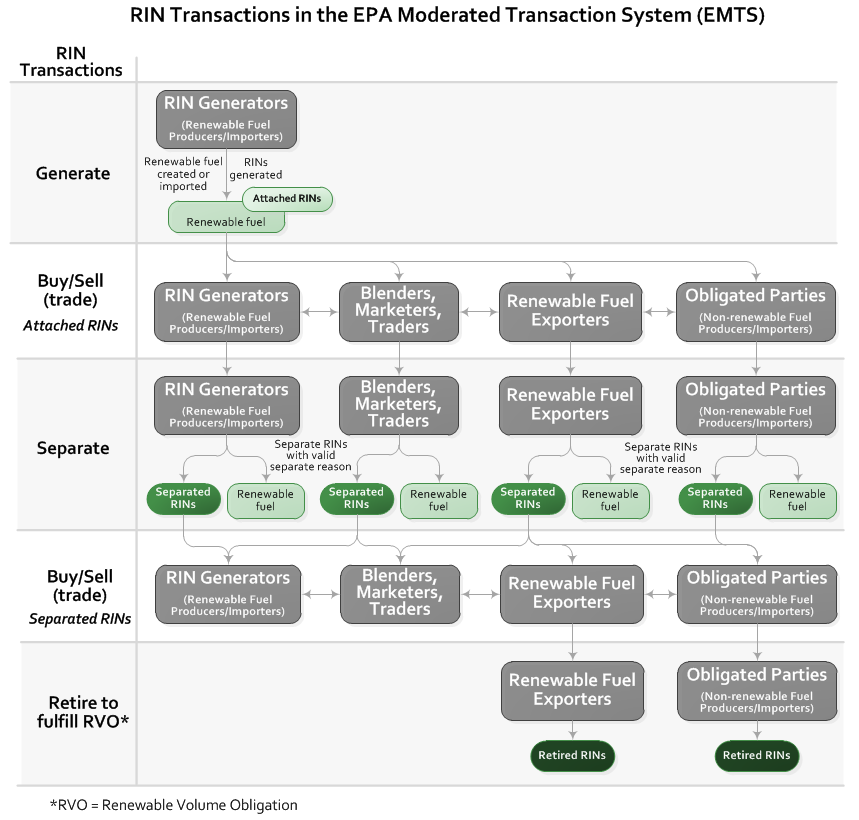
(a) RIN Generation and Assignment
- Generated when renewable fuel is produced or imported.
- Assigned to physical fuel batches.
- Detached when blended with fossil fuel.
(b) RIN Trading and Market Oversight
- RINs can be bought/sold in secondary markets.
- Creates a compliance flexibility mechanism.
- Vulnerable to fraud → requires strong governance.
(c) RIN Retirement (Compliance Demonstration)
- Obligated parties must retire sufficient RINs annually.
- Demonstrates compliance with Renewable Volume Obligations (RVOs).
(d) Reporting and Recordkeeping
- Mandatory reporting to EPA via EMTS (EPA Moderated Transaction System).
- Audit trails required for verification.
(e) Internal Controls and Risk Management
- Due diligence on counterparties.
- Segregation of duties in trading and compliance teams.
- Fraud detection mechanisms.
3. Governance Risks in RIN Systems
- Fraudulent RIN Generation (fake biodiesel production)
- Double Counting or Invalid RINs
- Market Manipulation
- Weak Internal Controls
- Regulatory Non-Compliance Penalties
4. Key Case Laws on RIN Compliance Governance
(1) United States v. Clean Green Fuel, LLC (2013)
- Fraudulent generation of biodiesel RINs without actual production.
- Court upheld criminal liability for RIN fraud.
- Principle: RINs must correspond to genuine fuel production.
(2) United States v. Absolute Fuels, LLC (2015)
- Creation of millions of fake RINs.
- Defendants convicted of conspiracy and fraud.
- Principle: Strict enforcement of RIN authenticity and traceability.
(3) United States v. Green Diesel, LLC (2017)
- Misrepresentation of feedstock and production volumes.
- EPA invalidated RINs.
- Principle: Transparency in feedstock sourcing is essential.
(4) United States v. Quality Fuels, LLC (2018)
- False reporting and manipulation of RIN records.
- Criminal sanctions imposed.
- Principle: Accurate reporting is central to compliance governance.
(5) Monroe Energy, LLC v. EPA (2014)
- Challenge to EPA’s denial of hardship waiver from RFS obligations.
- Court upheld EPA’s authority.
- Principle: Regulatory discretion in enforcing RIN obligations is broad.
(6) Americans for Clean Energy v. EPA (D.C. Cir. 2017)
- Addressed EPA’s waiver authority and RVO setting.
- Court limited EPA’s ability to reduce volumes based on demand constraints.
- Principle: Integrity of statutory renewable fuel targets must be preserved.
5. Regulatory Enforcement Mechanisms
(a) Civil Penalties
- Per-day/per-violation fines under Clean Air Act.
(b) Criminal Liability
- Fraudulent RIN schemes prosecuted as federal crimes.
(c) RIN Invalidations
- EPA may invalidate improperly generated RINs.
(d) Third-Party Audits
- Mandatory Quality Assurance Programs (QAPs).
6. Corporate Governance Best Practices
(1) Robust Due Diligence
- Verify biofuel producers before purchasing RINs.
(2) Compliance Programs
- Dedicated RIN compliance officers.
- Written policies aligned with EPA rules.
(3) Audit and Assurance
- Internal audits + third-party QAP verification.
(4) Technology Controls
- Automated RIN tracking systems.
- Blockchain-based traceability (emerging practice).
(5) Training and Awareness
- Regular staff training on RFS compliance.
7. Comparative Insight (Global Perspective)
- The RIN system resembles:
- EU Emissions Trading System (ETS)
- Carbon credit markets
- Common governance themes:
- Credit authenticity
- Market integrity
- Regulatory oversight
8. Analytical Conclusion
RIN Compliance Governance is a hybrid regulatory-market system combining:
- Environmental law
- Financial market regulation
- Corporate governance controls
The jurisprudence demonstrates a zero-tolerance approach to fraud, emphasizing:
- Traceability
- Transparency
- Accountability
Failures in governance often lead to:
- Criminal prosecution
- Financial penalties
- Reputational damage
RELATED Blog

comments